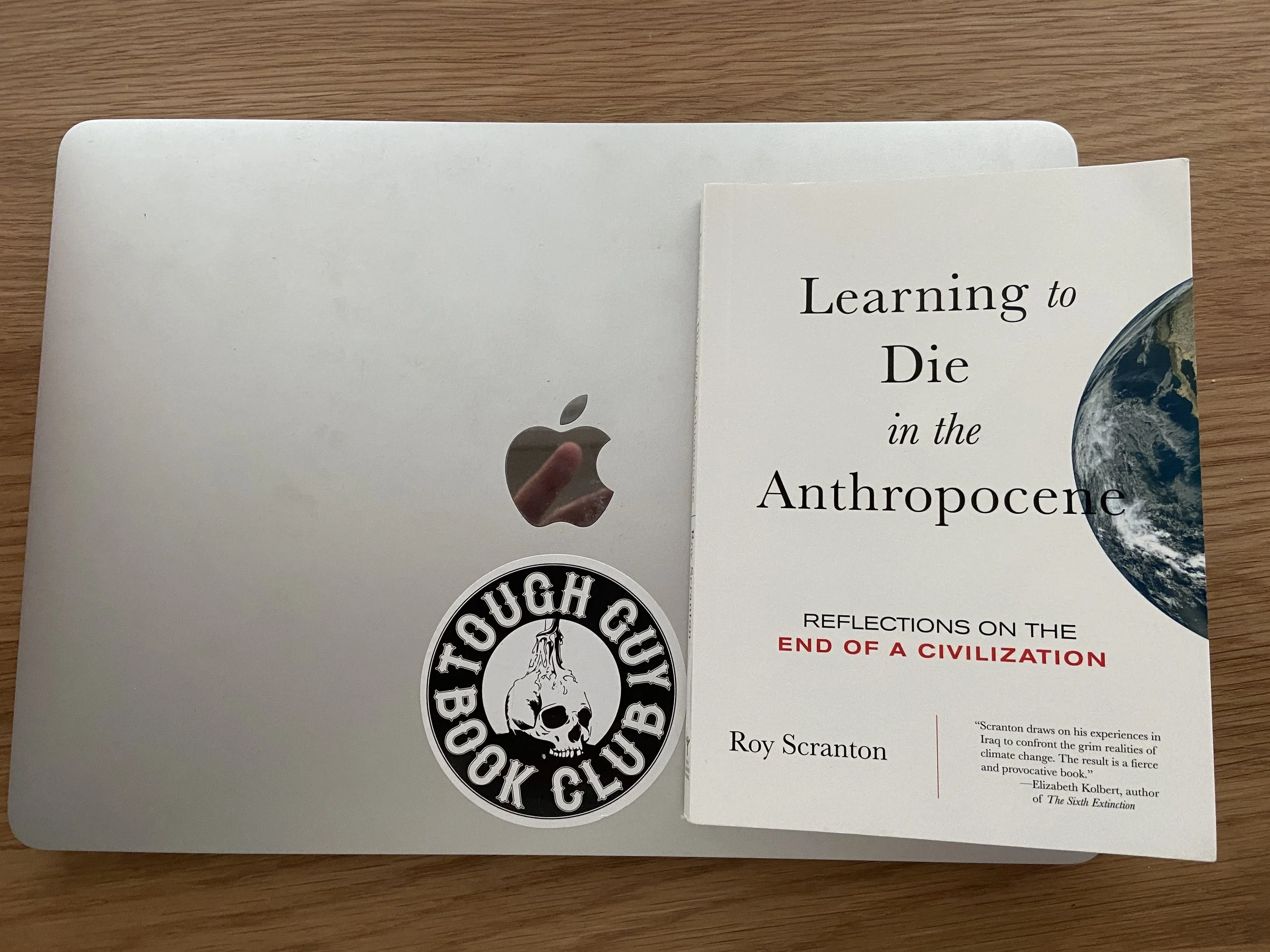
Learning to Die in the Anthropocene
Cheery topic this, but not everything can be barbecue, glass of red and a good read on a sunny afternoon.
Roy Scranton is an interesting and busy guy. He is an ex-US Army veteran with tours in Iraq, a writer, he holds a PhD in English, teaches as an Associate professor and has written four other books and lots of essays and articles.
Learning to Die started as a longish award-winning essay and is now a quick and mostly fascinating read as a book. For three quarters it is powerful and thought provoking but when it comes to the conclusion the book seems to me to falter. But I better go to the guts of the topic first.
Basically Roy feels we, meaning civilisation and most of us, are fucked, the walking dead, and there is not a thing we can do about it. Climate change, the carbon-based world economy and unfettered capitalism have already pushed us passed the point of rescue or salvation. We are the problem and we lack the will, the structures, and the power against the establishment to save ourselves. How we got to this and why what we are trying to do about it is either not working or too little too late is laid out brutally and clearly in the first three quarters of the book. It is compelling, angry and sombre reading.
The next quarter of the book touches on a number of possible ways to cope with this future. Hence the Learning To Die in the title. Accepting death has never been easy but in the modern world we do everything to fight it, to avoid it. Roy believes what is coming will be easier if we rethink our relationship with death and see life in a way that seems much closer to a Buddhist viewpoint. Learning to let go and face death is just as much part of being a soldier in combat as being a conservation focussed human on the way to a new enlightenment.
Roy, rather perfunctorily in the last section, then goes on to look at how Philosophy and indeed the humanities may be able to play a role in, if not avoiding the coming catastrophe, at least make the upheaval easier to bear. It is also a plea to make sure that most valuable thing a civilisation can leave behind are their records and memory as they generate thought, ideas and provide guidance. We only know a fraction of the writings from Ancient civilisations in the Mediterranean and the Middle East and look what they brought about in a few thousand years.
Finally, and this is another chapter that deserved further expansion, Roy lists out his thoughts on the Universe. As he sees it, basically the universe just is and our part in it is destined to be what it always was going to be. Species become extinct, civilisations rise and fall and eventually even stars die. We have learnt so much over the last few thousand years but we will never know a fraction of the universe. Why do we keep denying our part in this massive interconnectivity?
I liked this book and frankly found what some might call pessimism, defeatism or self-fulfilling prophecy, a bloody refreshing and realistic take on the whole state of play of the world today. I am less convinced on his conclusions but I would agree that a lot more critical thinking and a better understanding of our past and our duty to the future might at least set us up better for next time, whenever that is. If you would like some music to accompany this message may I suggest the wonderful chamber pop of XTC. The music genius of Andy Partridge and Colin Moulding ( the Brian Wilsons of Swindon) have produced many great tunes. in this case their 1984 track This World Over is a perfect accompaniment.
Learning to Die in the Anthropocene
Roy Scranton
City Lights Books
2015
142PP